XPeng AeroHT Says Full-Scale A868 Has Flown Through Its First Tilt Transition
The Chinese flying-car developer calls it the country's first full-scale demonstration of an all-tilting rotor layout moving from hover into wing-borne flight.
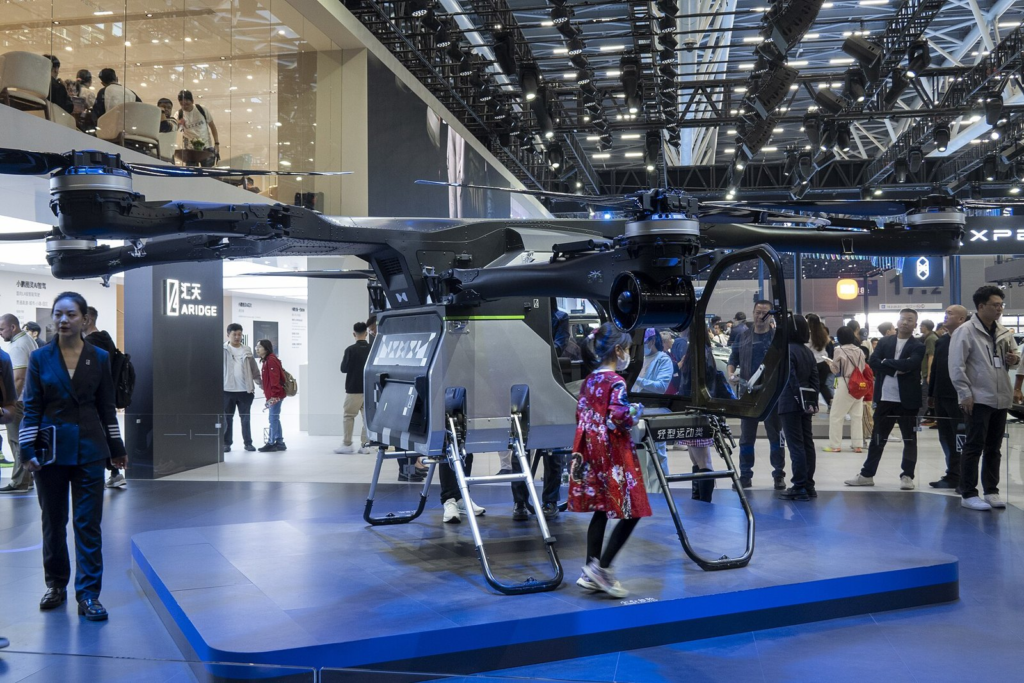
XPeng AeroHT, the flying-car arm of Chinese automaker XPeng, announced on Nov. 22 that its full-scale A868 prototype has completed a tilt-transition test flight, according to reports from Internet Info Agency and HiTech.Expert. The company said the milestone makes it the first in China to carry out such a flight with a full-scale, fully tilting rotor aircraft.
A tilt transition is the phase in which an electric vertical takeoff and landing aircraft leaves hover, swings its rotors forward and settles into fast horizontal flight on its wing. Developers regard it as a far harder test than hovering, because the aircraft passes through a regime in which lift is shared between rotors and wing while the control laws have to keep everything stable.
Why the rotor layout matters
The A868 uses what the industry calls a full-tilt configuration: every rotor rotates between a vertical position for takeoff and a horizontal one for cruise. The alternative semi-tilt layout tilts only some rotors and leaves the rest fixed for lift, which is simpler but adds drag and dead weight once the aircraft is cruising. XPeng AeroHT argued that the all-tilting design gives cleaner aerodynamics in cruise, and HiTech.Expert likened the arrangement to an electric take on the Osprey tiltrotor.
Globally, the reports noted, Joby Aviation in the United States has already completed tilt-transition flight validation, while other developers pursuing the layout have not yet reached that stage, and some have opted for semi-tilt or different architectures altogether.
Two product lines
XPeng AeroHT said the A868 is being aimed at multi-passenger business travel over medium and longer distances. It is meant to sit alongside the company’s Land Aircraft Carrier, a ground vehicle that carries a smaller detachable passenger aircraft intended for recreational flying. Together, the company said, the two products define its strategy of pairing leisure flight with practical air mobility.
The announcement covers a test flight of an experimental prototype. The company has not said the A868 is certified or when it might be offered to customers, and the reports did not give details of the flight’s duration, altitude or location.
Sources
- Internet Info Agency (news18a.com) · Nov 22, 2026
- HiTech.Expert · Nov 22, 2026